
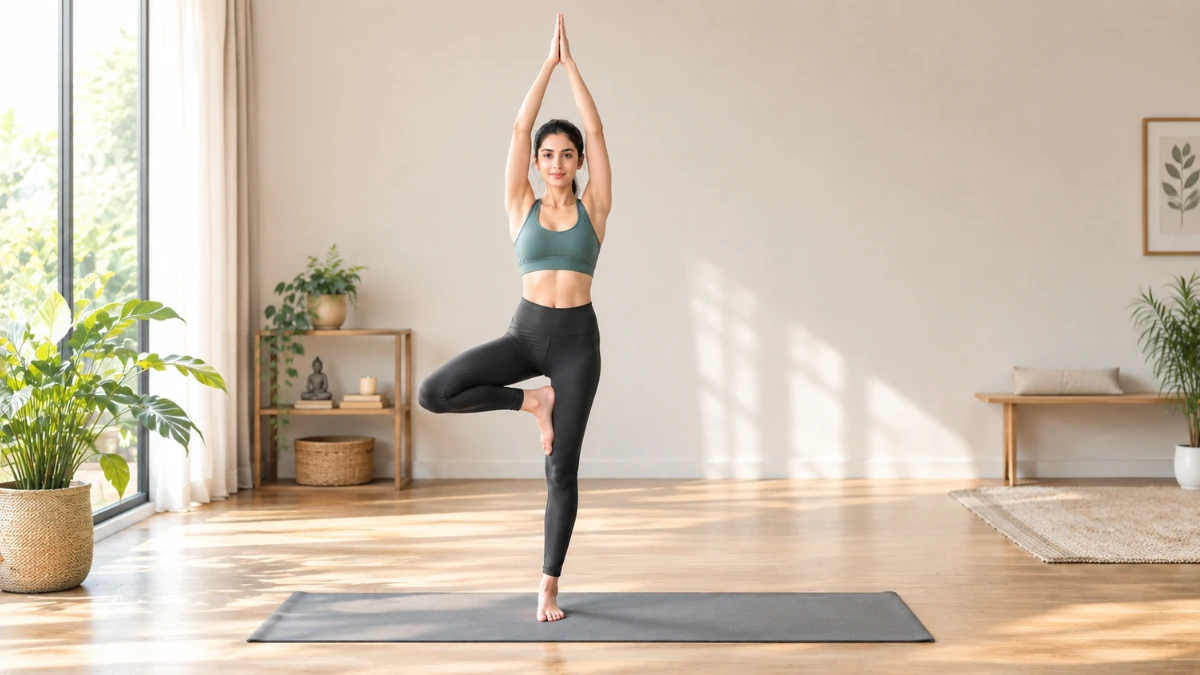
Good balance helps you move with more control, stay steady during everyday activities, and feel more confident in your body. If you often wobble during one-leg poses or find it difficult to stay stable, adding simple yoga poses for balance to your routine can be a practical place to start.
You don’t need to be flexible or experienced to work on your balance. The 7 poses below range from simple standing positions to more challenging balance poses, so beginners can start at their own level and gradually build stability, strength, and body awareness.
In This Article
What Does Balance Mean in Yoga?
Balance in yoga means controlling your body while staying steady and aware of your position. Static balance involves holding a stable position, such as Tree Pose, while dynamic balance involves staying controlled as you move from one position to another.
Balance can feel difficult for beginners because it depends on several parts of the body working together. Your core and leg muscles help keep you stable, while your ankles make small adjustments to prevent you from losing your position. Your focus and breathing also play an important role.
If you’re new to yoga, don’t worry if some poses feel unsteady at first. Research suggests that yoga may help improve balance and physical function with regular practice. [NCCIH]
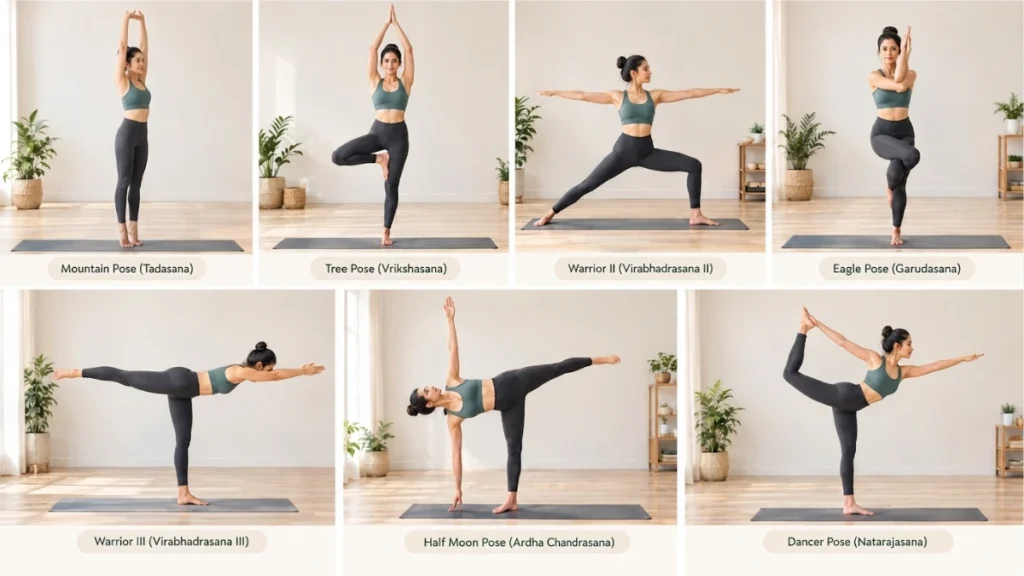
7 Best Yoga Poses for Balance
1. Mountain Pose (Tadasana)
Mountain Pose is a simple foundation for improving balance, posture, and body awareness. Although both feet remain on the floor, the pose teaches you to distribute your weight evenly and maintain a steady, upright position.
How to do it:
- Stand with your feet about hip-width apart.
- Distribute your weight evenly between both feet.
- Keep your legs active without locking your knees.
- Lengthen your spine and relax your shoulders.
- Let your arms rest naturally by your sides.
- Look straight ahead and take slow, steady breaths.
Beginner tip: Practice near a wall if needed and focus on keeping your weight evenly distributed between both feet.
2. Tree Pose (Vrikshasana)
Tree Pose is a beginner-friendly one-leg balance pose that challenges your stability while improving body awareness and control. It also teaches you to stay focused while your body makes small adjustments to remain steady.
How to do it:
- Stand tall with your feet together or hip-width apart.
- Shift your weight onto your left foot.
- Bend your right knee and place the sole of your right foot against your inner calf or thigh. Avoid placing it directly on your knee.
- Bring your hands together at your chest or raise them overhead.
- Keep your gaze fixed on one point and breathe slowly.
- Hold for several breaths, then switch sides.
Beginner tip: If balancing on one leg feels difficult, keep the toes of your raised foot on the floor beside your standing foot for extra support.
3. Warrior II (Virabhadrasana II)
Warrior II is a standing pose that builds lower-body strength while helping you develop stability and control. Because both feet stay grounded, it provides a useful foundation before moving into more challenging one-leg balance poses.
How to do it:
- Stand with your feet wide apart.
- Turn your right foot outward and bend your right knee over your ankle.
- Keep your left leg straight and press your foot firmly into the floor.
- Extend your arms out to the sides at shoulder height.
- Keep your chest lifted and gaze over your right fingertips.
- Hold for several steady breaths, then repeat on the other side.
Beginner tip: Keep your front knee comfortably bent and focus on keeping both feet grounded and your torso upright.
4. Eagle Pose (Garudasana)
Eagle Pose challenges your balance by narrowing your base of support while your legs and arms work together. It can also help you practice concentration and controlled movement, making it a useful progression after simpler standing poses.
How to do it:
- Stand tall with your feet together.
- Bend your knees slightly and shift your weight onto your left foot.
- Lift your right foot and cross your right thigh over your left thigh.
- If comfortable, wrap your right foot behind your left calf.
- Cross your arms in front of you and bring your palms together if possible.
- Keep your chest lifted and gaze at one steady point.
- Hold for a few breaths, then slowly unwind and switch sides.
Beginner tip: You don’t need to wrap your foot completely around your standing leg. Simply crossing the thighs while keeping the toes lightly on the floor is a good starting point.
5. Warrior III (Virabhadrasana III)
Warrior III is a more challenging balance pose that works on single-leg stability while engaging the legs and core. It requires you to control your body as you lean forward, making it a useful progression after practicing easier standing poses.
How to do it:
- Stand tall with your feet hip-width apart.
- Shift your weight onto your left foot.
- Slowly extend your right leg backward as you lean your torso forward.
- Keep your hips as level as possible and extend your arms forward or alongside your body.
- Continue lifting your back leg until your torso and leg are roughly parallel to the floor.
- Keep your standing leg strong and gaze toward the floor.
- Hold for a few steady breaths, then slowly return to standing and switch sides.
Beginner tip: Use a wall or keep your fingertips on a sturdy surface while learning the pose. You do not need to lift your back leg very high to practice the balance.
6. Half Moon Pose (Ardha Chandrasana)
Half Moon Pose challenges your balance while also requiring control through your standing leg, hips, and core. It can be a useful progression once you feel comfortable with simpler one-leg poses such as Tree Pose and Warrior III.
How to do it:
- Begin in a standing position and step your left foot back slightly.
- Place your right hand on the floor or a yoga block beside your right foot.
- Shift your weight onto your right leg as you lift your left leg behind you.
- Open your hips and chest toward the side while extending your left arm upward.
- Keep your lifted leg active and your standing knee slightly soft.
- Look forward or gently toward your raised hand if comfortable.
- Hold for a few steady breaths, then slowly return to standing and switch sides.
Beginner tip: Place your supporting hand on a yoga block or use a wall for stability. Focus on keeping your body controlled rather than lifting your leg as high as possible.
7. Dancer Pose (Natarajasana)
Dancer Pose is a challenging standing balance pose that combines stability, leg strength, and flexibility. It requires you to balance on one leg while reaching the other leg backward, making it a good progression for people who are already comfortable with simpler balance poses.
How to do it:
- Stand tall with your feet together.
- Shift your weight onto your left foot.
- Bend your right knee and bring your right heel toward your hip.
- Hold the inside or outside of your right foot with your right hand.
- Slowly extend your right leg backward as you lean your torso slightly forward.
- Reach your left arm forward and keep your gaze on one steady point.
- Hold for a few slow breaths, then gently release and switch sides.
Beginner tip: Use a wall for support and focus on staying steady rather than lifting your back leg high. Stop if you feel pain or strain.
How to Practice Yoga for Better Balance
Improving balance with yoga takes regular practice rather than trying to master difficult poses quickly. Start with the easier poses and gradually move toward more challenging ones as your stability improves.
- Practice on a firm, non-slippery surface.
- Keep your gaze fixed on one point during standing balance poses.
- Breathe slowly instead of holding your breath.
- Practice both sides of the body.
- Use a wall or sturdy support when needed.
- Focus on controlled movements rather than holding a pose for as long as possible.
- Practice consistently and give yourself time to improve.
Even a few minutes of focused balance practice can help you become more comfortable and controlled in these poses over time.
Safety Tips for Yoga Balance Poses
Balance poses can be challenging, especially when you’re new to yoga. A few simple precautions can make your practice more comfortable and reduce the risk of losing your balance.
- Practice on a stable, non-slippery surface.
- Keep a wall or sturdy support nearby when trying a new pose.
- Don’t force your body into a position just to hold the pose longer.
- Come out of the pose if you feel sharp pain, dizziness, or unusual discomfort.
- Start with easier poses before progressing to more challenging one-leg poses.
- If you have an injury or a health condition that affects your balance or movement, consider getting guidance from a qualified healthcare or fitness professional before practicing challenging poses.
Frequently Asked Questions
Can beginners do yoga poses for balance?
Yes. Beginners can start with simple poses such as Mountain Pose, Tree Pose, and Warrior II before progressing to more challenging one-leg poses. If you feel unsteady, practice near a wall or use another sturdy support. Balance may take time to develop, so focus on controlled movements rather than trying to hold a difficult pose immediately.
How long should you hold a yoga balance pose?
If you’re a beginner, start with about 3 to 5 slow breaths, or as long as you can maintain comfortable control and good form. As your balance improves, you can gradually hold the pose for longer. There’s no need to stay in a pose until you start wobbling excessively or lose proper alignment.
What should I do if I keep losing my balance during yoga?
Start with an easier pose and use a wall or sturdy support while you practice. Keep your gaze fixed on one steady point, distribute your weight carefully, and breathe normally instead of holding your breath. Small movements and occasional wobbling are normal when you’re learning. With regular practice, you can gradually improve your stability and control.
Can yoga help improve balance and stability?
Yes. Balance-focused yoga poses can help you practice coordination, body awareness, muscle control, and the ability to maintain a steady position. Poses that challenge your standing leg, core, and overall control can be useful as part of a regular exercise routine. Consistency matters more than attempting advanced poses before you’re ready. [PubMed]
Do yoga balance poses improve core strength?
Some yoga balance poses engage the core muscles to help keep your body stable and controlled. Poses such as Tree Pose, Warrior III, Half Moon Pose, and Dancer Pose require your trunk to remain steady while your body changes position. However, balance poses are only one way to strengthen the core, so they can complement rather than replace other core-strengthening exercises.
Final Thoughts
Better balance doesn’t come from getting every pose right on the first try. It develops gradually as you practice controlling your movements, building strength, and becoming more aware of your body. Start with the poses that feel comfortable, use support when needed, and gradually challenge yourself as your stability improves.
With regular practice, these yoga poses for balance can become a simple part of your routine. Focus on consistency rather than perfection, and give your body time to adapt.
