
Yoga for PCOD is often surrounded by endless lists of poses promising better hormone balance, faster periods, weight loss, or even a “natural cure.” If you have PCOD or PCOS, you may have come across these claims. But PCOS is more complex than that, and no single yoga pose can fix every symptom. So, can yoga actually help—and what can these poses realistically do?
Research suggests that yoga may be a useful part of a broader lifestyle approach for people with PCOS. Studies have reported potential benefits in areas such as metabolic health, hormonal and menstrual outcomes, and psychological wellbeing, although the evidence is still developing and studies have used different types, intensities, and durations of yoga. The 2023 International Evidence-Based Guideline for PCOS also recommends healthy lifestyle behaviours and physical activity as part of PCOS management.
Instead of promising a quick fix, this guide focuses on five beginner-friendly yoga poses you can add to your routine. For simplicity, each pose is held for around 30 seconds in this routine, with simple instructions, practical tips, and an honest look at what each pose can—and cannot—actually do.
In This Article
Can Yoga Help With PCOD or PCOS?
First, a quick terminology note: PCOS (polycystic ovary syndrome) is the established medical term used in clinical guidelines. “PCOD” is still widely used in everyday conversation and online searches. Since many people search specifically for “yoga for PCOD,” this article uses both terms where relevant.
Yoga combines physical postures with breathing and, in some practices, meditation. For someone with PCOS, its value is less about finding a special pose that targets the ovaries and more about having a form of movement that can be practical, enjoyable, and sustainable.
What Does That Mean in Practice?
Yoga may be useful for:
- building regular movement into your day
- improving flexibility and mobility
- developing body awareness and balance
- supporting relaxation and stress management
- making physical activity feel more manageable and consistent
But there is an important distinction: these are potential benefits of yoga as a form of physical activity—not proof that a particular asana can treat PCOS itself. Research on yoga specifically in PCOS has reported promising findings in some areas, but studies differ in the types of yoga used, how often participants practised, and which outcomes were measured.
So, rather than asking which pose “balances hormones,” it is more useful to ask: Which poses can you practise comfortably and consistently as part of an overall active lifestyle? That is the approach used in the five-pose routine below.
5 Yoga Poses for PCOD
If you are new to yoga, you do not need a complicated sequence to get started. These five beginner-friendly poses can be practised as a simple routine. For this routine, start with around 30 seconds per pose, keep your breathing steady, and focus on comfortable movement rather than pushing into a deeper position.
The goal here is not to label any pose as a “PCOD cure” or “hormone-balancing” exercise. Instead, we’ll look at how to perform each pose, which muscles and areas of movement it involves, and how it can fit into a regular physical activity routine.
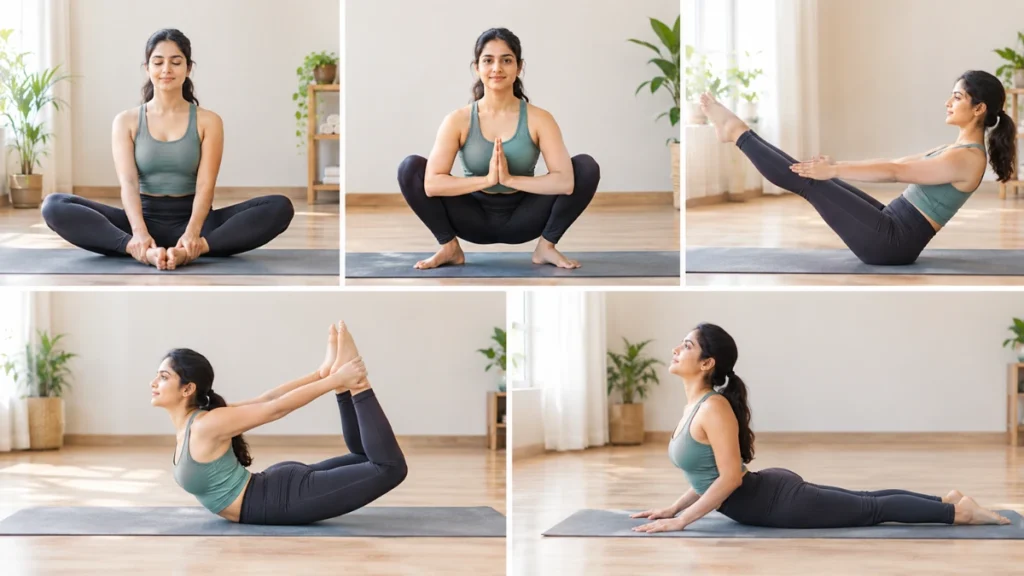
1. Butterfly Pose (Baddha Konasana)
Butterfly Pose (Baddha Konasana) is a seated yoga pose where the soles of the feet come together and the knees open outward. It provides a gentle stretch for the inner thighs and hips and can be a comfortable way to include lower-body mobility in a routine.
How to do it:
- Sit upright on a comfortable surface with your legs extended forward.
- Bend your knees and bring the soles of your feet together.
- Allow your knees to open outward naturally.
- Hold your feet or ankles comfortably.
- Keep your spine upright without forcing your posture.
- Hold the position for around 30 seconds, breathing slowly and comfortably.
What it can actually do:
Butterfly Pose mainly provides a gentle stretch through the inner thighs and hips and can support hip mobility. Because it is a relatively low-intensity movement, it can also work well as part of a gentle warm-up, cool-down, or beginner-friendly routine.
There is no good reason to describe Butterfly Pose itself as a “hormone-balancing” or PCOS-treating pose. Research on yoga and PCOS generally examines yoga programmes or practices as a whole, rather than the effects of one specific asana.
Beginner tip:
If your knees feel uncomfortable or sit much higher than your hips, place a folded cushion or yoga block under each knee for support. Let your knees relax naturally rather than pressing them toward the floor. If you feel sharp or persistent pain, stop the pose rather than forcing the stretch.
2. Garland Pose (Malasana)
Garland Pose (Malasana), also known as Yogi Squat, is a deep squatting position that involves the hips, knees, ankles, and lower-body muscles. Because it requires more range of motion than a simple standing or seated pose, it may feel challenging for beginners.
How to do it:
- Stand with your feet about hip-width apart or slightly wider.
- Slowly bend your knees and lower your hips toward the floor.
- Bring your hands together in front of your chest if comfortable.
- Keep your chest lifted and avoid rounding your back excessively.
- Hold the position for around 30 seconds, breathing normally.
What it can actually do:
Malasana engages the legs, glutes, and other lower-body muscles while taking the hips and ankles through a relatively deep range of motion. It can add lower-body strengthening and mobility work to a varied movement routine.
You do not need to reach a full deep squat for the pose to be useful. The appropriate depth depends on your mobility, balance, and comfort.
Beginner tip:
If you cannot comfortably reach the floor, place a folded blanket, cushion, or yoga block beneath your hips for support. If your heels lift naturally, you can place a folded mat or small support underneath them. Keep the movement controlled and avoid forcing your knees or ankles into a position that feels uncomfortable. Stop if you experience sharp or persistent pain.
3. Boat Pose (Navasana)
Boat Pose (Navasana) is more physically demanding than the first two poses. It requires your core and hip-flexor muscles to work together to help maintain the position.
How to do it:
- Sit with your knees bent and feet resting on the floor.
- Lean your upper body back slightly while keeping your chest open.
- Engage your abdominal muscles and lift your feet off the floor if comfortable.
- Keep your knees bent rather than straightening your legs if that helps you maintain control.
- Keep your spine as long as possible instead of rounding your back.
- Hold the position for around 30 seconds, or come out earlier if you can no longer maintain good form.
What it can actually do:
Boat Pose primarily challenges the core and hip-flexor muscles, making it a useful strengthening movement within a varied exercise routine. Keeping the position also requires some balance and body control.
However, doing Boat Pose does not specifically burn “PCOS belly fat” or directly correct insulin resistance. Changes in body composition and metabolic health depend on a much broader combination of factors, including overall physical activity, nutrition, sleep, and individual health factors.
Beginner tip:
You do not need to straighten your legs or hold the pose for the full 30 seconds immediately. Keep your knees bent and, if needed, keep your toes lightly touching the floor. As your strength and control improve, you can gradually work toward lifting your feet fully while maintaining good form.
4. Bow Pose (Dhanurasana)
Bow Pose (Dhanurasana) is performed lying on the stomach, with the ankles held behind the body as the chest and thighs lift from the floor. It combines a backbend with active work from several muscle groups, making it more demanding than the earlier seated poses.
How to do it:
- Lie on your stomach with your legs extended and arms resting alongside your body.
- Bend your knees and bring your heels toward your hips.
- Reach your arms back and hold your ankles if comfortable.
- Gently lift your chest and thighs while keeping the movement controlled.
- Keep your neck relaxed and avoid throwing your head backward.
- Hold the position for around 30 seconds, breathing steadily.
What it can actually do:
Bow Pose combines spinal extension with active work from the back, glutes, and leg muscles. Because several muscle groups work together to maintain the position, it can add strength, mobility, and body-control work to a varied yoga routine.
The aim is controlled movement, not lifting your chest or thighs as high as possible. A smaller, comfortable lift is perfectly acceptable, especially when you are new to the pose.
Beginner tip:
Do not force the backbend or pull aggressively on your ankles. If reaching your ankles is difficult, practise the movement with a smaller lift or without holding them first. Stop if you feel sharp or persistent pain, particularly in your lower back, knees, or shoulders.
5. Cobra Pose (Bhujangasana)
Cobra Pose (Bhujangasana) is a prone back-extension posture that can be adjusted to suit different levels of flexibility and strength.
How to do it:
- Lie on your stomach with your legs extended behind you.
- Place your palms beside your lower ribs, with your elbows close to your body.
- Keep the tops of your feet on the floor and gently lift your chest.
- Use your back muscles along with light support from your hands rather than pushing your body forcefully upward.
- Keep your shoulders relaxed and avoid forcing your lower back into a deeper bend.
- Hold the position for around 30 seconds if comfortable, breathing steadily.
What it can actually do:
Cobra Pose primarily involves spinal extension and gentle opening through the front of the body. It can be included in a mobility-focused yoga sequence and provides active work for the muscles along the back.
Its place in a PCOD routine comes from contributing to overall movement and mobility, not from evidence that the pose itself directly treats PCOS or changes reproductive hormones.
Beginner tip:
You do not need to lift your chest very high. A low, comfortable lift is enough. If you feel pressure, pinching, or pain in your lower back, reduce the height of the lift or return to the floor rather than trying to hold the full 30 seconds. Never force the backbend to make the pose look deeper.
What These Poses Can Actually Do
These five poses do not have to directly treat PCOS to be useful. Each one trains or stretches different parts of the body, so together they can add strength, mobility, flexibility, balance, and controlled movement to a regular routine.
- Butterfly Pose: gently stretches the inner thighs and supports hip mobility.
- Garland Pose: works the legs and glutes while challenging hip and ankle mobility.
- Boat Pose: challenges the core and hip-flexor muscles.
- Bow Pose: engages the back, glutes, and legs while working through spinal extension.
- Cobra Pose: gently works the back muscles and moves the spine into extension.
So, the realistic role of these poses is to keep you moving and build different aspects of physical fitness. They can be one part of an active lifestyle, but these five poses alone should not be considered a complete exercise programme for PCOS.
Their value in a PCOD-focused routine comes from these practical benefits—not from claims that a particular pose can cure PCOS, remove ovarian cysts, or “balance hormones.”
Can These Yoga Poses Help With PCOD Weight Loss?
They can contribute to an active lifestyle, but these five poses alone are unlikely to cause significant weight loss. They involve different muscle groups and add movement to your day, which can be useful when practised consistently alongside other forms of physical activity.
It is also not accurate to say that these poses specifically burn PCOD belly fat or target fat caused by PCOS. Changes in body weight and body composition depend on many factors, including overall physical activity, nutrition, sleep, metabolism, and individual health factors—not on one particular yoga pose.
It is also worth remembering that PCOS affects people differently, and weight is not the only measure of health or PCOS management. If weight management is one of your goals, a personalised approach that considers your overall health, preferences, and needs is more useful than relying on a specific set of yoga poses.
Frequently Asked Questions
1. Which yoga is best for PCOD?
There is no single yoga pose proven to be the “best” for PCOD. The five poses in this routine provide a mix of mobility, flexibility, core strength, and lower-body work, making them a practical starting point for beginners.
2. How long should I hold each yoga pose for PCOD?
For this routine, each pose is held for 30 seconds. If a pose becomes uncomfortable before 30 seconds, come out of it rather than forcing the hold.
3. Can these yoga poses help with PCOD weight loss?
They can contribute to your overall physical activity, but these five poses alone should not be expected to cause significant weight loss. They are better viewed as one part of an active lifestyle.
4. Can yoga cure PCOD or PCOS?
No single yoga pose or routine should be considered a cure for PCOS. Yoga can be included as part of a healthy, active lifestyle, but PCOS management may also require personalised medical care.
Final Thoughts
Yoga for PCOD does not need to be complicated to be useful. These five poses give you a simple way to include strength, mobility, flexibility, and controlled movement in your routine, with each pose offering something different.
The important part is keeping expectations realistic. No single asana can cure PCOS or guarantee changes in hormones, periods, or weight. Instead, think of yoga as one practical form of movement that can become part of a consistent, sustainable lifestyle.
Start at a level that feels comfortable, focus on good form, and give your body time to adapt. Consistency matters more than forcing yourself into a deeper pose or holding it longer. If you have PCOS and are concerned about irregular periods, weight changes, or other symptoms, yoga can complement your overall approach to health but should not replace appropriate medical care.
